10 min read
Commercial Carpets for Busy Business Premises
How to choose commercial carpets and carpet tiles for offices, retail spaces, and other busy business premises. Covers durability ratings, pile types, and fitting logistics across London, Guildford, and Woking.
- Written by
- Papstore Limited
- Published
- Updated
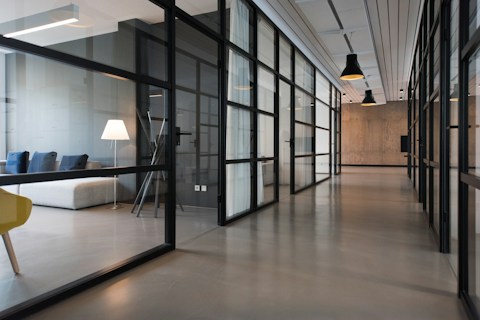
Commercial carpets need to work harder than anything you would put in a home. The foot traffic in an office, a retail shop, or a reception area can be many times greater than a residential hallway, and the carpet has to look professional day after day without showing premature wear. This guide explains what to look for when choosing carpet for business premises, with a focus on the practical details that separate a good commercial installation from one that disappoints within months.
What makes a carpet suitable for commercial use
Not all carpets are designed for commercial environments. Residential carpets are typically optimised for comfort and appearance in lower-traffic settings. Commercial-grade carpets are engineered differently, using denser pile constructions, tougher fibres, and heavier backings to withstand the demands of a working environment. When selecting carpet for a business, always check that the product carries a commercial wear rating rather than relying on residential specifications.
Understanding durability classifications
Commercial carpets in the United Kingdom are often rated using European standards that classify wear resistance. These ratings indicate how well the carpet maintains its appearance under sustained use. A higher classification means the product is designed for heavier traffic. For a small private office with two or three occupants, a moderate commercial rating may suffice. For an open-plan workspace, retail floor, or reception area in a busy London office building, you need the highest classification available.
Fibre choices for commercial carpet
The fibre used in a commercial carpet has a significant effect on performance and maintenance.
Nylon
Nylon is the dominant fibre in commercial carpet manufacturing. It offers excellent resilience, meaning it recovers well from foot traffic compression. Solution-dyed nylon, where the colour is added during the fibre manufacturing process rather than applied afterwards, provides superior fade resistance and stain performance. It is the go-to choice for offices, hotels, and high-footfall retail environments across London, Guildford, and Woking.
Polypropylene
Polypropylene is more affordable than nylon and offers good moisture and stain resistance. It suits lighter commercial applications such as small offices or meeting rooms that are used intermittently rather than continuously throughout the day. It flattens more readily under sustained heavy traffic, so it is less suitable for corridors and reception areas.
Wool blends
Some premium commercial installations use wool-blend carpets, particularly in settings where aesthetics are important, such as boutique hotels, boardrooms, and executive offices. Wool has natural fire resistance and a distinctive feel, but it requires more careful maintenance and comes at a higher cost per square metre.
Carpet tiles versus broadloom for business premises
One of the first decisions in a commercial carpet project is whether to use carpet tiles or broadloom (rolled carpet). Each format has distinct advantages depending on the type of business and the layout of the space.
Carpet tiles are modular, usually 50 centimetres square, and are loose-laid or lightly adhered to the subfloor. They are popular in offices because individual tiles can be lifted for access to underfloor cabling and replaced individually if damaged or stained. This makes long-term maintenance simpler and more cost-effective than replacing an entire section of broadloom.
Broadloom carpet, fitted from rolls, creates a more seamless appearance and is often preferred in reception areas, meeting rooms, and retail spaces where visual continuity matters. It is typically fixed with adhesive or stretch-fitted over gripper rods, depending on the subfloor and setting.
Pile types for heavy commercial traffic
The pile construction of a commercial carpet determines how it looks and how well it withstands daily use.
- Loop pile is the most hard-wearing construction for commercial use. The fibres form closed loops that resist crushing and maintain their height well under heavy foot traffic. Level loop carpets create a clean, uniform surface suited to offices and corridors.
- Cut pile has a softer surface and is used in areas where comfort is a priority, such as executive offices and hotel rooms. It shows footprints and vacuum tracks more readily than loop pile.
- Cut-and-loop blends combine both constructions to create textured patterns that disguise wear and add visual interest to larger floor areas.
Colour and pattern for commercial spaces
Colour choices in commercial carpet should balance brand identity with practical maintenance. Darker and mid-tone colours hide soiling better than light shades, which is important in entry areas and corridors. Many commercial carpet tile ranges offer coordinating colours that allow you to create zones, wayfinding paths, or accent areas within an open-plan office without changing the product specification.
Patterned designs and heather-effect textures are effective at masking wear and staining. They also add visual depth to large floor areas that might look monotonous in a plain colour. For businesses in Guildford and Woking looking to create a distinctive interior without overspending, a well-chosen pattern can achieve a lot.
Fire performance and building regulations
Commercial buildings are subject to fire safety regulations that specify minimum performance standards for floor coverings. Any carpet installed in a commercial setting must meet the relevant British Standard for critical radiant flux, commonly referred to as the Bfl classification. Your flooring supplier should be able to confirm compliance before you commit to a product, and certification should be retained for your building safety file.
Fitting logistics for occupied premises
Installing carpet in a working office, shop, or business premises requires planning. Unlike a residential project, you may need to work around opening hours, move IT equipment safely, protect stock, and minimise disruption to employees or customers. Many commercial installations are carried out in phases, completing one section at a time so that the business can continue to operate. Weekend and out-of-hours fitting is another option for businesses that cannot afford downtime during the working week.
Maintenance and lifecycle planning
Commercial carpet benefits from a planned maintenance regime. Regular vacuuming, periodic hot-water extraction cleaning, and prompt treatment of spills all extend the useful life of the carpet. Carpet tiles have an advantage here because damaged or heavily soiled tiles can be swapped without touching the rest of the floor. Building a small stock of spare tiles at the time of installation is a simple way to manage ongoing maintenance costs.
For businesses across London, Guildford, and Woking looking for commercial carpet that balances durability, appearance, and budget, Papstore Limited offers supply and fitting tailored to the demands of busy working environments.